By Visiblo • 5 Jun 2026 • 20 min read
How to Audit Your Brand's AI Footprint Across LLMs | Complete Guide for 2026
Understanding How LLMs Reference Brands
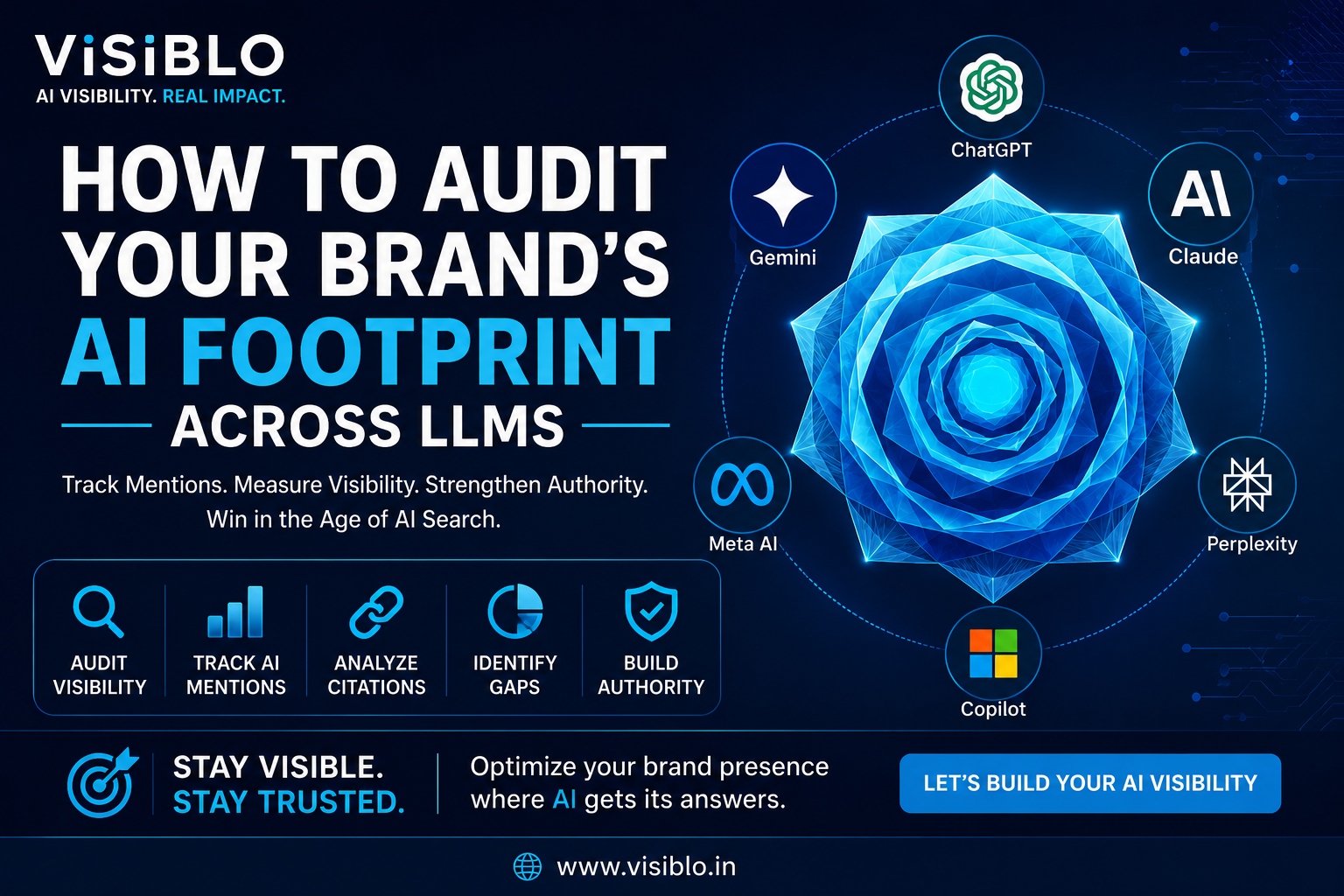
How to Audit Your Brand's AI Footprint Across LLMs
Introduction
The rise of Large Language Models (LLMs) such as ChatGPT, Gemini, Claude, Perplexity, and Microsoft Copilot has transformed how people discover information online. Instead of relying solely on traditional search engines, users now ask AI assistants for recommendations, product comparisons, company information, and industry insights.
As a result, brands must pay attention to a new form of visibility: their AI footprint.
Your AI footprint refers to how often, how accurately, and in what context your brand is mentioned, cited, or recommended by AI systems. A strong AI footprint can increase brand awareness, trust, and lead generation, while an inaccurate or weak presence can result in missed opportunities.
This guide explains how to audit your brand’s AI footprint across major LLMs and improve your visibility in AI-driven search experiences.
What Is an AI Footprint?
An AI footprint is the collection of information AI models use when generating responses about your brand.
This includes:
Brand mentions
Website content
Industry citations
Reviews and ratings
News coverage
Directory listings
Social media references
Expert contributions
Third-party articles
The stronger and more consistent these signals are, the more likely AI systems are to recognize and reference your business.
Why Auditing Your AI Footprint Matters
As AI-powered search continues to grow, brands need to understand how they are represented across different platforms.
Benefits of auditing your AI footprint include:
Identifying inaccurate brand information
Discovering missing citations
Measuring AI visibility
Improving brand authority
Enhancing customer trust
Increasing opportunities for AI-generated recommendations
A regular audit helps ensure your brand remains visible and accurately represented across AI ecosystems.
Step 1: Test Your Brand Across Major LLMs
Start by searching for your brand on leading AI platforms.
Check:
ChatGPT
Google Gemini
Perplexity AI
Claude
Microsoft Copilot
Ask questions such as:
What does this company do?
Is this company trustworthy?
What services does this brand offer?
Who are this company’s competitors?
Why should customers choose this business?
Document every response and compare results across platforms.
Step 2: Evaluate Brand Accuracy
Review the information provided by each AI system.
Check whether:
Company name is correct
Services are accurate
Location information is updated
Contact details are correct
Industry positioning is clear
Brand messaging is consistent
Even small inaccuracies can affect customer perception and trust.
Step 3: Analyze AI Citations
Many AI platforms now cite sources when generating answers.
Identify:
Which websites are being cited
Whether your website appears as a source
Which competitor websites receive more citations
Which content formats are frequently referenced
This helps reveal where AI systems are gathering information about your brand.
Step 4: Monitor Competitor Visibility
Compare your AI footprint against key competitors.
Evaluate:
Number of brand mentions
Quality of recommendations
Citation frequency
Content visibility
Authority signals
If competitors are consistently appearing in AI-generated responses while your brand is not, there may be content or authority gaps that need attention.
Step 5: Review Online Brand Signals
AI systems rely on multiple online sources when understanding a business.
Audit your presence across:
Google Business Profile
Industry directories
Review websites
Social media platforms
News publications
Business listings
Partner websites
Ensure all information is consistent and up to date.
Step 6: Evaluate Content Coverage
Content plays a major role in AI visibility.
Review whether your website covers:
Core services
Industry FAQs
Case studies
How-to guides
Expert insights
Comparison articles
Customer success stories
Brands with comprehensive content are more likely to be referenced by AI systems.
Step 7: Check Brand Authority Signals
Authority remains one of the strongest indicators used by both search engines and AI systems.
Evaluate:
Backlink profile
Domain authority
Industry mentions
Guest contributions
Media coverage
Awards and certifications
Strong authority signals increase the likelihood of AI citations.
Common AI Footprint Issues
Many businesses discover the following problems during an audit:
Incomplete Brand Information
AI tools may provide limited or outdated details.
Weak Content Authority
Insufficient content reduces the likelihood of AI references.
Lack of Citations
Competitors may receive more AI citations due to stronger content ecosystems.
Inconsistent Business Data
Conflicting information across directories creates confusion for AI systems.
Limited Online Presence
Brands with few mentions across trusted websites often struggle to gain AI visibility.
How to Improve Your AI Footprint
Publish High-Quality Content
Create:
Industry guides
Service pages
Research-based articles
Expert insights
Strengthen Brand Mentions
Increase visibility through:
Digital PR
Guest posting
Industry publications
Business directories
Improve Structured Content
Use:
Clear headings
FAQs
Tables
Bullet points
Schema markup
Build Authority
Focus on:
Quality backlinks
Reviews
Testimonials
Industry recognition
Maintain Accurate Information
Keep all business details consistent across platforms and directories.
Key Metrics to Track
Monitor:
AI citations
Brand mentions
Referral traffic
Branded search volume
Backlink growth
Review volume
Directory listings
Content performance
Tracking these metrics helps measure improvements in AI visibility over time.
The Future of Brand Visibility
Traditional SEO is no longer the only way customers discover businesses. AI assistants are becoming a primary source of information, recommendations, and purchasing decisions.
Brands that actively monitor and improve their AI footprint will be better positioned to maintain visibility, build authority, and attract customers in the evolving search landscape.
Conclusion
Auditing your brand’s AI footprint is becoming an essential part of modern digital marketing. By evaluating how your business appears across major LLMs, analyzing AI citations, reviewing authority signals, and improving content quality, you can strengthen your presence in AI-powered search environments.
The brands that succeed in the future will not only rank well on search engines but will also become trusted sources that AI systems confidently reference and recommend.